The Job Nobody Thought He Could Hold
How NurseLink Healthcare's NDIS Support Helped A Warrnambool Family See Their Son Take His First Real Job
A Case Study In Employment Support That Built The Job Around The Person, Not The Other Way Around
Introduction
For most young people, a first job is a rite of passage. It is a mix of nerves and pride, an early taste of independence and the first time the world treats you, however briefly, as someone with something to contribute. For young people with an intellectual disability, the same milestone can feel much further away. Families are often told, kindly and with good intentions, that open employment may not be realistic. Over time, they begin to say it themselves.
Yet the evidence from people with intellectual disability who do work is consistent. Meaningful work builds confidence, widens social networks and changes how a person is seen, by employers, by neighbours and by themselves. The barrier is rarely the person’s capacity. It is the lack of a bridge: someone to help find the right role, to teach the job in a way that makes sense, and to stay alongside long enough for the person and the workplace to find their rhythm.
This is the territory of NDIS employment and capacity-building support. It is also where families need the most reassurance, because the stakes feel high. A failed placement can set a young person back, and the fear of that outcome can keep families from trying at all. This case study documents how NurseLink Healthcare supported a family in Warrnambool whose son, a young man with an intellectual disability, took his first open-employment job, and how treating the family as part of the process helped everyone move from doubt to pride.
To protect the privacy of the participant and his family, all names and identifying details have been kept confidential throughout this case study.
The Family & Their Situation
The family lives in Warrnambool, on Victoria’s south-west coast, and consists of two parents, in their fifties, and their son, a young man of twenty-one who is the NDIS participant. He also has an older sister who lived in Melbourne and visited on school holidays and special occasions.
The participant lives with a mild to moderate intellectual disability. He is friendly, funny and intensely loyal, with a good memory for routines and a deep love of animals. He reads simple text with some effort and manages money with support. He had attended a special school and then a post-school day program, where he had been happy and well liked, but where, as his mother put it, the days had begun to feel like waiting.
His parents were the kind of parents who had done everything right. They had attended every meeting, fought for every support and built a calm, loving home. They also had a quiet, unspoken fear that their son’s life was, in a sense, already mapped out. Employment had been raised in plans before, and each time, the conversation had ended in a list of reasons why it might not work: the pace of a workplace, the risk of being let go, the possibility of being treated unkindly. His father had worked at the same company for thirty years and could not quite imagine his son in that world. His mother worried about the first time her son came home upset.
The participant, meanwhile, had been telling anyone who would listen that he wanted a job. He watched his sister and cousins with pay slips and uniforms and he wanted the same. In his planning meeting, when asked what he would like to do, he said, with great seriousness, that he wanted to work with animals and have his own name tag.
Understanding What The Family Actually Needed
The NurseLink Healthcare coordinator who joined the family in the early stages of his plan recognised that the participant’s goal was clear and genuine. What stood between him and employment was not a lack of readiness, but a set of practical and emotional obstacles that nobody had yet worked through systematically.
The participant needed a role that matched his interests and strengths, an employer who understood how to work with him, and a structured way to learn the job. He needed someone alongside him, at least at first, who could translate between his way of learning and the workplace’s way of working. He needed time to build confidence, and a plan for what would happen if things did not go smoothly.
His parents needed something that is harder to define: permission to hope, backed by a plan that took their fears seriously. They needed to know that a placement would be carefully chosen, that their son would not be left to sink or swim, and that any difficulty would be addressed quickly and kindly. They needed, too, a way to let go gradually, without feeling they had abandoned him.
His employer, once found, would need clear information, practical training and reassurance that support would be available. Small businesses, particularly in regional areas, often want to do the right thing but are unsure how.
The NurseLink Healthcare Solution
Starting With The Participant's Interests, Not A Job List
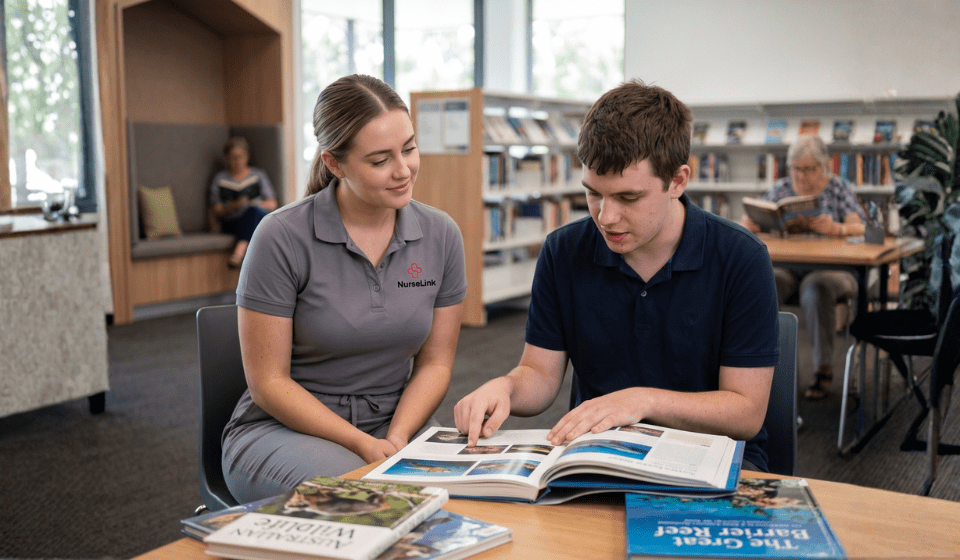
Rather than begin with a list of available positions, the NurseLink Healthcare team began with a conversation. A support worker with experience in disability employment spent time with the participant exploring what he enjoyed, what he was good at and what he wanted. Animals came up repeatedly. So did routines, tidiness and helping people. These became the starting points for the job search.
Finding An Employer Through Local Relationships
The support worker approached a small local business, a pet supplies and produce store on the edge of town, whose owner was known in the community and had previously expressed interest in hiring locally. Rather than present the participant as a placement, the support worker presented him as a candidate with specific strengths: reliability, enthusiasm, a memory for product locations and a genuine love of animals. The owner agreed to a short, unpaid work trial.
A Trial That Worked For Everyone
The trial was structured carefully, beginning with a few hours a week and tasks that suited his strengths, restocking shelves, tidying the pet food aisle, helping customers find items and greeting animals that came in with their owners. The support worker attended each session, then gradually moved from working beside him to observing from a distance, and finally to checking in by phone. The employer was shown how to give instructions in short, clear steps, and was given a simple one-page guide to the participant’s communication preferences.
Teaching The Job In The Way He Learns
The support worker created visual task lists, with photos and simple words, which the participant could use independently. Over time, he learned the layout of the store, the names of the main products and the routines for opening and closing. The employer commented that he picked things up faster than some of his previous casual staff.
Involving The Parents As Partners, Not Observers
The coordinator met regularly with the participant’s parents, sharing progress, explaining what the support worker was doing and why, and inviting their observations. They were encouraged to visit the store as customers and see their son at work, which they did, a little nervously at first. His mother later said that watching her son help a customer find dog food, with his name tag on his shirt, was one of the moments she would never forget.
Planning For Difficulty Before It Happened
Together, the coordinator, the participant, his parents and the employer wrote a short plan for what would happen if something went wrong. Who to call, how to handle a difficult customer, what to do if he felt overwhelmed. Having this plan in place eased the family’s fears and gave the employer confidence.
Gradually Reducing Support As Confidence Grew
As the participant settled into the role, the amount of on-site support was reduced in steps, always in consultation with him and his family. The aim, the coordinator explained, was not to remove support but to match it to what he needed, so that he could experience the pride of managing more and more himself.
Supporting Travel, Money & Daily Routines
Alongside the job itself, the coordinator and support worker helped the participant with the surrounding skills that made employment sustainable: learning the bus route to work, managing his pay and building a morning routine that got him to the store on time. These skills were taught in the same practical, step-by-step way as the job.
Outcomes & Impact
He Moved From Trial To Paid, Ongoing Work
After a successful trial, the participant was offered a regular paid position for a set number of hours each week, with a contract and a name tag. The employer said the decision had been easy, and that the store had become a happier place.
His Confidence & Independence Grew Visibly
Within months, the participant was travelling to work independently, managing his tasks with little prompting and chatting easily with customers. His parents described him as standing taller. He began to talk about saving for something of his own.
His Parents' Fears Eased
His mother and father spoke of a shift they had not expected. The worry that had shadowed so many conversations about their son’s future gave way, gradually, to a cautious optimism. His father said he had stopped thinking in terms of what his son could not do, and had begun to think about what might come next.
The Workplace Benefited
The store’s owner reported that the arrangement had been good for the business as well as for the participant. Regular customers had come to know him, and the staff team had become more patient and inclusive. He later offered to speak to other local employers about his experience.
His Social World Widened
The participant made friends at work, was invited to the team’s end-of-year barbecue and began to be recognised around town. His sister, visiting at Christmas, remarked that he seemed like a different person: grown up, proud and entirely himself.
A Reflection From The Participant's Mother
Several months into the job, the participant’s mother shared the following with the NurseLink Healthcare coordinator:
She said that for years she had quietly believed that employment was something other families got to talk about, and that her son’s pay slip, which she kept on the fridge, was the most beautiful piece of paper she had ever seen. What changed things for her was a support worker who believed in her son without ever making her feel foolish for being afraid, and a coordinator who treated the family as part of the team. She said the first week, she had waited by the phone for a call that never came, and that when she finally went to the shop on the Friday, her son had looked up from a shelf, grinned and said that he was busy. She added that she had spent twenty-one years preparing for the worst, and that she was now learning, slowly and happily, to prepare for the best.
Key Takeaways From This Case Study
Meaningful employment starts with the person’s interests, not with the job market. Beginning with what the participant loved led to a role that suited him and kept him motivated.
Local relationships open doors that formal applications often cannot. A small business owner who knew the community was more willing to give a trial than a larger employer with a rigid process.
Teaching the job in the way the person learns is as important as finding the job itself. Visual task lists and short, clear instructions helped the participant succeed and helped the employer feel confident.
Families need a plan for difficulty as much as they need encouragement. Agreeing in advance what would happen if something went wrong gave the family the courage to try.
Support should reduce gradually, matched to growing confidence. Stepping back in stages allowed the participant to experience real independence without being left unsupported.
Conclusion
A young man who had been telling everyone he wanted a job, and a family who had learned not to hope too hard, found through patient, practical NDIS employment support that the job was possible. For the family at the centre of this case study, NurseLink Healthcare provided not only a support worker and a plan, but a way of seeing their son’s future as something that could be built, step by step, together.
He wears his name tag every shift. His pay slip is on the fridge. And a Warrnambool family has learned that the job nobody thought he could hold was, all along, one he was ready for.
If someone in your family has an intellectual disability and wants to work, we encourage you to reach out to the NurseLink Healthcare team. We build the job around the person, and we support the whole family along the way.
Latest Post
When Parents Learned to Trust NDIS Support

The Life He Thought The Accident Had Collapsed
Someone Finally Holding The Whole Picture
A Home That Was Finally His Own
Learning To Do It Herself, With Someone Beside Her
What Was Still Possible

Finding Her Way Back To Her Own Kitchen Table
From Aged Care To Her Own Front Door
She Was Ready. We Helped Her Get There.
Room To Breathe
The Man He Was Getting Back To
They Did Not Give Up On Him
Returning To Community Life
Rebuilding Independence After A Diabetes-Related Amputation
Cooking By Heart
The World Beyond The Front Door
Finding Home Again After A Stroke
Relearning Independence After A Life-Changing Accident

Beyond The Diagnosis
Two Years In Care. One Giant Step Toward Home.
When Transport Barriers Disrupted NDIS Care

Supported Independent Living Success
A Journey Towards Independence With NDIS Support

Daniel’s Journey