From Aged Care To Her Own Front Door
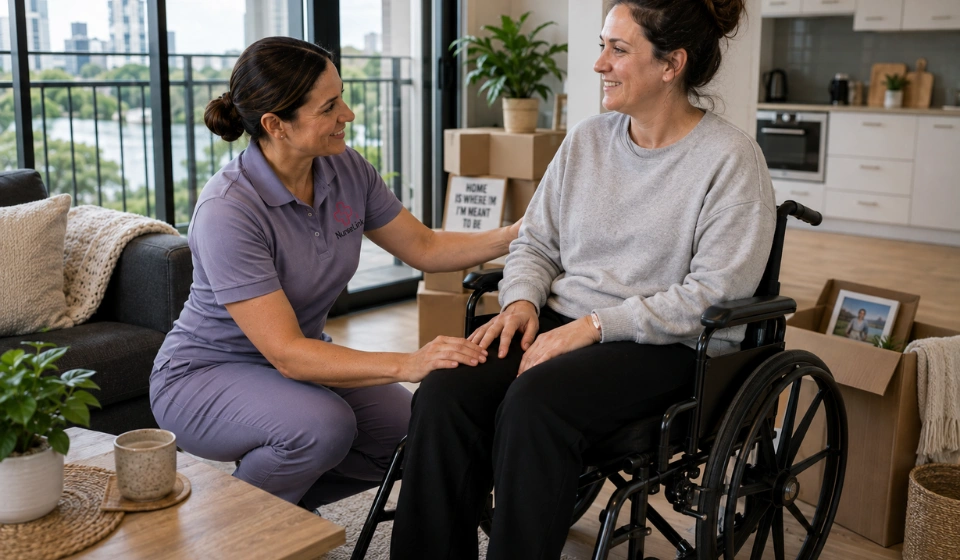
How NurseLink Supported A Woman With A Spinal Injury Back Into Community Living
A Brisbane NDIS Case Study In Spinal Injury Support, Housing Transition & Independence
Introduction
There are people living in aged care facilities in Australia who are not old. They are there because a spinal injury or an acquired disability arrived without warning and the system, faced with the immediate and pressing question of where they should go, chose the option that was available rather than the option that was right. They are there because the NDIS support required to live in the community had not yet been organised, because the suitable housing had not been identified, because the coordination of everything that independent community living requires had not happened at the speed that the person’s discharge from hospital had required.
They are there, in their thirties or their forties, in facilities built for people at the end of their lives, surrounded by a rhythm and a culture and an environment that has nothing to do with where they are in theirs. And the longer they are there, the harder it becomes to leave, not because leaving is impossible but because the momentum of the system runs toward staying and the effort required to reverse it is enormous, and the person who needs to generate that effort is already managing the physical and emotional demands of a serious disability without the support that would make the effort possible.
The NDIS exists, in its most purposeful form, to make that reversal possible. To provide the support that allows a person with a serious disability to live in the community, in a home that is theirs, with the assistance they need to do so safely, rather than in a facility that was not designed for them and that cannot offer what community life offers.
At NurseLink Healthcare, we understand that NDIS support in this context is not simply a service. It is the practical infrastructure of a return to a life that has been waiting. This case study documents how our team supported a woman in her late thirties in Brisbane, Queensland, to leave the aged care facility where she had been living since her spinal injury and to return to the community, and what that return required and what it made possible.
To protect the privacy of the client and her family, all names and identifying details have been kept confidential throughout this case study.
The Client & Her Situation
The client is a woman in her late thirties who had been living in Brisbane when a medical event, a spinal cord haemorrhage that arrived without warning during an ordinary weekday morning, left her with an incomplete spinal cord injury at the thoracic level. She had been a graphic designer, working freelance from home, living in a rental apartment she had shared with a close friend and maintaining the particular kind of independent, active life that a person in her late thirties in a city she had lived in for most of her adult life builds without thinking much about it.
The haemorrhage had been managed in the acute setting with the speed and the clinical thoroughness that its severity demanded. She had survived. The injury had left her with significant lower limb impairment, requiring a wheelchair for mobility, and with upper limb function that was partially affected in ways that required adaptation but that had not been entirely lost. She had spent several months in spinal rehabilitation, working with a team that had been, by her account, excellent in their clinical management and honest in their prognosis.
When discharge from the rehabilitation facility had been planned, the question of where she would go had not been resolved. She did not have family in Brisbane who could provide the level of support her discharge required. The apartment she had been sharing was not wheelchair accessible and its modification was not feasible. An NDIS plan had been initiated but had not yet been developed to the point where the community support required for her to live independently had been confirmed and arranged. And the rehabilitation facility needed the bed.
The aged care facility had been presented as a temporary solution. A place to go while the NDIS plan was developed and the housing was found and the support was organised. She had agreed because she had not had a better option, and because temporary had sounded, at the time, like something that would resolve itself within months.
She had been there for over a year when NurseLink Healthcare first became involved.
What Aged Care Had Been Like
The aged care facility was not a bad facility. The staff were, by her account, kind and the clinical care was adequate. The problem was not the quality of the care within the context of what the facility was designed to provide. The problem was that the context was wrong and everything that followed from that wrongness accumulated across the months of her stay in ways that were difficult to fully articulate and impossible to ignore.
She was the youngest person in the facility by several decades. The rhythms of the place were organised around the needs and the preferences and the capacities of people who were at a very different stage of life. The activities, the mealtimes, the social structure, the particular quiet of a facility where most of the people living in it had narrowed their world to the dimensions of the facility itself, none of it had anything to do with who she was or where she was in her life.
She had continued to work, partly. Her graphic design work had migrated entirely to her laptop and she managed what she could from her room, which was both a practical necessity and one of the things that kept her connected to the version of herself that existed before the injury. But the working conditions of a room in an aged care facility were not the working conditions of a person whose professional life had been built around the creative energy of a self-directed working day, and the work she was managing was a fraction of what she had done before.
She had friends who visited. Fewer as the months went on, not because the friendships had ended but because the logistics of visiting a friend in an aged care facility across the city, regularly and over the long term, were logistics that even devoted friends managed imperfectly. The social life that had been one of the things she valued most about her life before the injury had contracted to the dimensions of a visiting schedule that was both valued and insufficient.
She had not stopped trying to leave. From the first month of her stay, she had been engaging with the NDIS planning process, working with a plan coordinator to develop the support plan that would make community living possible. The process had been slower than it should have been, for reasons that were partly systemic and partly specific to the complexity of her situation. She had, by the time NurseLink Healthcare became involved, a plan that was further developed than it had been a year earlier and that was, in the assessment of her plan coordinator, approaching the point where the right provider could translate it into the community living arrangement that had been the goal since discharge.
Her plan coordinator referred her to NurseLink Healthcare.
Understanding What She Actually Needed
The initial conversation NurseLink Healthcare had with her was one that she had clearly prepared for, because she had been preparing for it, in various forms, for over a year. She knew what she needed. She had thought about it carefully and had arrived at a clarity about the practical requirements of her community living that the months of planning had produced.
She needed supported independent living in a wheelchair-accessible property in Brisbane, either alone or with a compatible housemate, with daily support that covered the personal care and daily living tasks that her injury made difficult without covering the things she could manage independently, which she assessed, correctly, as more than most support plans assumed for a person with her level of injury.
She needed support workers with specific spinal injury experience who understood the clinical requirements of her level of injury, including bowel and bladder management, skin integrity monitoring and the specific handling requirements that her upper limb involvement produced. She needed these things delivered with the professional competence that made them clinical tasks rather than ordeals, and with the personal respect that made her home feel like her home rather than a care environment.
She needed, and this she said with a directness that the care coordinator found both entirely clear and entirely moving, to get out of the aged care facility. Not eventually. As soon as it was safely and practically possible. She had been there for over a year and she was thirty-eight years old and the life she intended to live was not in that building.
The care coordinator, who had been working in disability support for long enough to have met people in exactly this situation before, understood everything she had said and confirmed that NurseLink Healthcare could help her make it happen.
The NurseLink Healthcare Solution
Coordinating The Community Living Transition
The first and most significant contribution NurseLink Healthcare made to her situation was not a support visit. It was the coordination of the practical elements of her community living transition that had been the missing piece between an NDIS plan that described what she needed and a community living arrangement that actually existed.
NurseLink Healthcare’s care coordinator worked alongside her plan coordinator to identify suitable wheelchair-accessible housing in Brisbane, coordinate the assessment of shortlisted properties against her specific physical requirements and assist with the practical arrangements of the move itself. She was involved in every decision, which was both the right approach and the one she had specified as non-negotiable, because she had been having decisions made around her for over a year and she was not going to start her community living by having that continue.
The property identified was a ground-floor unit in an inner Brisbane suburb, wheelchair accessible throughout, with the space and the configuration that her daily functioning required. It was close to public transport, close to the cafes and the streets and the ordinary infrastructure of city life that she had missed more than she had known how to say in the facility. She visited it before committing. She sat in the living room for a long time. She told the care coordinator it would do, which the care coordinator understood, correctly, as considerable enthusiasm expressed in the manner of a person who was not yet willing to fully believe that the thing she had been working toward for over a year was actually happening.
Support Workers Selected For Clinical Skill & Personal Compatibility
NurseLink Healthcare’s selection of support workers for her ongoing daily living support was driven by the clinical requirements of her spinal injury management and by the equally important personal requirements of a woman who had made clear that her home was going to be her home and that the people coming into it needed to be people she could live alongside rather than people she had to manage.
The support workers identified had specific spinal injury care experience, including proficiency in the bowel and bladder management programme her rehabilitation team had established, skin integrity monitoring that was structured around the specific pressure injury risk profile of a person with her level of injury and the handling and transfer techniques that her upper limb involvement required. These were the clinical foundations of the placement.
Beyond the clinical credentials, NurseLink Healthcare had assessed the personal qualities of the candidates against what she had described. She needed people who would arrive in her home and function as competent professionals doing their jobs, not as carers doing her a favour. She needed people who would take their lead from her about what she needed and when, who would not anticipate needs she had not expressed and who would manage the clinical tasks of each visit with the matter-of-fact efficiency that made them routine rather than significant.
She met both support workers before the move, in the aged care facility, and formed her own assessment of whether they were people she could work with. She confirmed they were. The care coordinator noted that the confirmation had been given more readily than she had expected, which she took as evidence that the selection had been well-matched.
The Day She Left
The move from the aged care facility to the unit happened on a Tuesday morning. Her friends, several of whom had maintained their presence across the year of the facility stay with a consistency she had not taken for granted, helped with the moving. Her primary support worker was there. Her plan coordinator was there. The care coordinator was there.
She had not brought much with her to the facility when she had arrived, because temporary had been the expectation. What she was moving into the unit was mostly new, chosen in the weeks before the move in the particular way that a person selects things for a space that is going to be theirs. There were things on the walls before the afternoon was over. There was food in the refrigerator that she had chosen. There was a desk by the window where she was going to work.
She sat in her living room that evening after everyone had gone. Her primary support worker had completed the last visit of the day and had left at the time they had agreed. She was alone in her own space for the first time in over a year.
She called her mother, who lived interstate and who had been part of the planning for the move without being able to be there for it. She told her she was home. Her mother asked what it felt like. She said it felt like hers.
Daily Support That Built Her Independence
The daily support NurseLink Healthcare provided in her new home was structured around the principle that had informed everything else about the engagement. She was the person managing her own life, and the support was there to make that possible, not to substitute for it.
Morning care was delivered with the clinical precision and the personal efficiency that allowed her to begin her working day without the morning having consumed more of her than was necessary. Bowel and bladder management was conducted according to the programme her rehabilitation team had established and was monitored and documented in the way that her ongoing clinical management required. Skin integrity checks were incorporated into every visit, because the pressure injury risk that came with her level of injury and her wheelchair use was not something that could be managed intermittently.
She returned to her graphic design work in a way that she had not been able to in the facility, because the working environment of her own home, with the desk by the window and the quiet of a space that was organised around her needs, was the working environment that her professional life required. Her workload began to recover within the first months. By the sixth month of the community living arrangement, she was working at a level that was meaningfully closer to her pre-injury capacity than anything she had managed in the facility.
Reconnecting With Her Community
The social reconnection that the move made possible was, by her account, the dimension of the change that she had not fully anticipated the depth of until she was living it. Her friends could visit without the logistics of an aged care facility visit. She could meet them out, at the cafes and the places that had been her city before the injury. She could have people over for dinner, which she did within the first month, with her support worker’s assistance with the preparation and her own clear management of everything else, because hosting was hers and she had no intention of delegating it.
The Brisbane that had been her city for most of her adult life was available to her again, in the adapted but genuine way that a wheelchair user in a reasonably accessible city navigates it. She was in it, which was the thing that mattered most and that the aged care facility, for all its adequacy within its own terms, had not been able to give her.
Outcomes & Impact
She Left Aged Care
The outcome that had been the goal of the engagement from its first conversation was the outcome that was achieved. She left the aged care facility. She moved into a home that was hers. She was thirty-eight years old and living in the community, which was where a thirty-eight-year-old with a spinal injury and an NDIS plan and the right support belonged and where she had been working to get for over a year.
This outcome required the coordination of housing, support planning, clinical placement and practical logistics that NurseLink Healthcare had contributed to alongside her plan coordinator and the other members of her support team. It had not happened automatically and it had not happened quickly. But it had happened, and the significance of it was not lost on anyone involved.
Her Professional Life Recovered
The recovery of her professional life across the months of the community living arrangement was one of the outcomes that she returned to most often when she described what the change had meant. Graphic design had been both her livelihood and a significant part of her identity, and the diminished version of it she had managed in the facility had been one of the more painful features of the year she had spent there. In her own home, with the right environment and the right support structure around her, it returned in a way that she had not been certain was still possible.
Her Social Life Was Restored
The social life that had contracted across the year of the facility stay expanded again in the months following the move, not instantly or completely, because a year of contraction does not reverse itself overnight, but genuinely and progressively. The friendships that had survived the facility year were the friendships that met her in her own home and in her city, in the ordinary way of friends who can now simply be friends rather than visitors managing the logistics of visiting.
The System Had Been Made To Work For Her
The broader significance of her outcome was not only personal. She was a young woman who had been placed in aged care because the system had not been able to organise the alternative in time, and who had spent over a year in the wrong place while the alternative was slowly assembled. NurseLink Healthcare’s involvement had been the piece that translated an NDIS plan that described what she needed into a community living arrangement that actually existed. That translation was the system working as it was supposed to work, and it had taken the right provider, the right coordination and the right commitment to make it happen.
A Reflection From The Client
Several months into her community living arrangement, she shared the following with the NurseLink Healthcare care coordinator:
“I spent fourteen months in a place that was kind to me and completely wrong for me. I am thirty-eight. I had a life and a career and a city and friends, and all of it was waiting for me to get back to it. NurseLink helped me get back to it. Not by doing it for me but by making the practical things possible so I could do it myself. I am working again. I had people over for dinner last week. I go to the same coffee shop I used to go to before the injury. It is not the same life I had before. But it is mine, and it is here, and that is everything I was trying to get back to.”
Key Takeaways From This Case Study
Young people with disabilities in aged care represent a systemic failure that the NDIS can correct. A person in their thirties or forties in an aged care facility because the right community support was not organised in time is not in the right place. The NDIS exists to make community living possible for people with serious disabilities, and a provider that understands how to translate an NDIS plan into an actual community living arrangement is the piece that makes the correction happen.
The transition from aged care to community living requires coordination, not just support. Identifying suitable housing, assessing it against the participant’s specific requirements, coordinating the practical logistics of the move and ensuring the support is in place before the transition happens requires active coordination effort that goes beyond the provision of daily support visits. NurseLink Healthcare’s contribution to this engagement extended well beyond the clinical care.
Daily living support for a spinal injury participant must be clinically precise and personally respectful simultaneously. The clinical requirements of spinal injury support are significant and non-negotiable. The personal requirements of a young woman who is managing her own life are equally significant and equally non-negotiable. NurseLink Healthcare’s approach held both without treating either as secondary to the other.
The right environment is a clinical factor in rehabilitation and recovery. A person with a spinal injury who is living in an environment that is designed for them, that supports their independence and that connects them to the social and professional life that forms their identity, will recover differently than one who is living in an environment that is not designed for them. The environment is not incidental to the outcome. It is part of it.
Conclusion
She was thirty-eight years old and she was living in an aged care facility because the right support had not been organised in time and the system had put her where it could rather than where it should. She had spent over a year working to change that, and NurseLink Healthcare had been the provider that had helped her change it.
She is in her own home in Brisbane. She is working. She is having people over for dinner. She is in her city, in her life, in the place that the year in the facility had been keeping her from.
The NDIS made it fundable. NurseLink Healthcare made it real.
If you or someone you know is living in aged care with a disability and is ready to explore what community living could look like, we encourage you to reach out to the NurseLink Healthcare team. We understand what the transition requires and we are here to help make it happen.
Latest Post
When Parents Learned to Trust NDIS Support
The Life He Thought The Accident Had Collapsed
Someone Finally Holding The Whole Picture
A Home That Was Finally His Own
Learning To Do It Herself, With Someone Beside Her
What Was Still Possible
Finding Her Way Back To Her Own Kitchen Table
From Aged Care To Her Own Front Door
She Was Ready. We Helped Her Get There.
Room To Breathe
The Man He Was Getting Back To
They Did Not Give Up On Him
Returning To Community Life
Rebuilding Independence After A Diabetes-Related Amputation
Cooking By Heart
The World Beyond The Front Door
Finding Home Again After A Stroke
Relearning Independence After A Life-Changing Accident
Beyond The Diagnosis
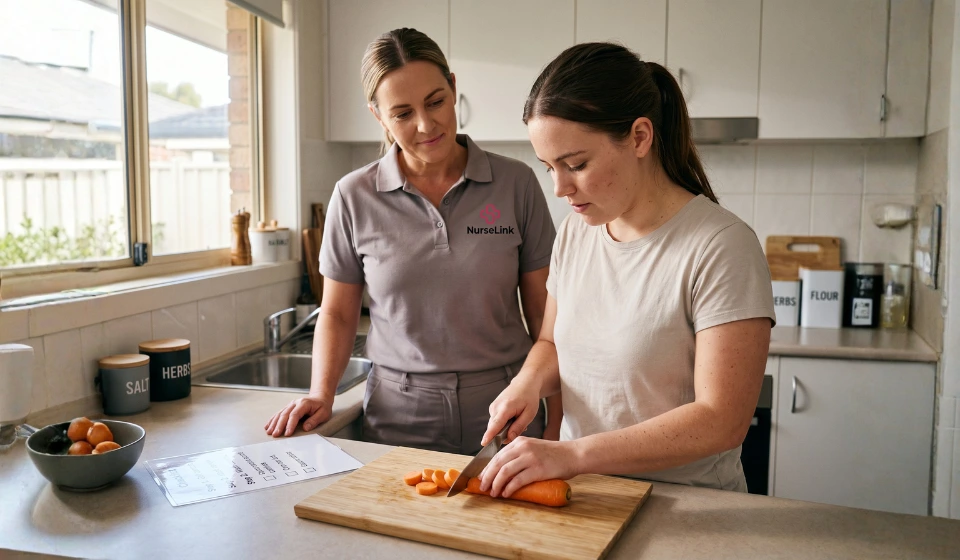
Two Years In Care. One Giant Step Toward Home.
When Transport Barriers Disrupted NDIS Care
Supported Independent Living Success
A Journey Towards Independence With NDIS Support
Daniel’s Journey