
Finding Her Way Back To Her Own Kitchen Table

How NurseLink Supported An Mother To Rebuild Daily Life & Connection After A Major Depressive Episode
A Case Study In NDIS Psychosocial Support That Helped A Family Come Back Together, Slowly And On Her Terms
Introduction
There is a particular kind of collapse that happens inside a family home, quietly, without an ambulance or a hospital admission to mark the moment it began. It is the collapse of a parent who has, for years, been the one who held everything together, the appointments, the meals, the school forms, the small daily maintenance of a household, and who then, through no failure of character or effort, simply cannot do it anymore.
Major depressive and anxiety episodes do not always arrive as a single dramatic event. Often they arrive as an accumulation, a slow erosion of capacity that a parent tries to compensate for, quietly and privately, for far longer than is sustainable, until the compensation itself runs out and the household that depended on her can no longer function the way it once did.
NDIS psychosocial support in these situations exists to do two things at once, and both matter equally. It exists to help the person rebuild her own functional capacity, and it exists to help repair the practical and emotional structure of the family that has been living inside the collapse alongside her. Neither can really succeed without the other.
This case study documents how NurseLink Healthcare supported a mother in her early forties in Adelaide, following a major depressive and anxiety episode that had significantly eroded her capacity to manage her home and her role within her family, through a combination of consistent support work and gradual, carefully paced help reconnecting socially, both with her family and beyond it.
To protect the privacy of the participant and her family, all names and identifying details have been kept confidential throughout this case study.
The Participant & Her Family
The participant is a mother of two, a boy of fourteen and a girl of eleven, living in Adelaide’s eastern suburbs with her husband. Before the episode that brought her into contact with NurseLink Healthcare, she had, by her own description and by her family’s, been the organiser of the household in the way that falls, still very often, to one parent more than the other. She managed the household budget, the children’s school commitments, most of the cooking, most of the social calendar for the family, and did all of it, for years, while also working part time in administration for a local business.
The decline had not been sudden. It had built gradually across the better part of a year, beginning with a period of what she described as persistent low mood and exhaustion that she had attributed, initially, to simple overwork and had tried to push through in the way she had always pushed through difficult periods before. But this one did not resolve the way earlier difficult periods had. It deepened. She stopped being able to manage the household tasks she had once handled easily. She stopped, for stretches of time, being able to leave the house at all without significant anxiety. She withdrew from the small network of other parents and friends who had once been a regular part of her week, not because anything had gone wrong between them but because the effort of maintaining those connections had become more than she had left to give.
Her husband, doing his best to hold the practical gaps together around his own full-time job, had reached a point of considerable strain himself by the time she was formally diagnosed and began treatment with a psychiatrist, which included a period of more intensive support before she was assessed as ready to be at home full time, managing her recovery with appropriate support in place. Her children, old enough to notice that their mother had become someone quieter, more withdrawn and less available than the mother they knew, had absorbed the change in ways that worried both parents considerably, her son in particular becoming withdrawn himself over the preceding months.
Her NDIS access, once granted, included funding for psychosocial support designed to help her rebuild daily functional capacity and, over time, reconnect with the social and family relationships that the episode had disrupted. Her support coordinator referred the family to NurseLink Healthcare, having worked with the service previously on comparable psychosocial recovery engagements and having confidence in the approach.
Understanding What The Family Actually Needed
The initial assessment conversation, conducted primarily with the participant herself but with her husband present for part of it, was approached carefully by the NurseLink Healthcare care coordinator, who understood from the referral notes that the participant was managing not only her own recovery but a considerable weight of guilt about the impact her illness had had on her family.
She was direct, once the conversation had settled into something less formal than an assessment, about what had been hardest. It was not, she said, the low mood itself so much as the sense of having disappeared from her own family’s daily life, of her children eating dinners she had not made, of missing things at their school that she would once have been at without a second thought, of her husband managing bedtime routines and forms and appointments that had always been hers to hold. She wanted, more than any single symptom resolved, to feel like herself again inside her own home.
Practically, she needed support re-establishing a manageable daily structure, help with some of the household tasks that had become overwhelming while she rebuilt her own capacity for them, and support gradually re-engaging with the small social connections, other parents at the school gate, a friend she had once seen weekly, that had fallen away during the worst of the episode. She was clear that she did not want to be pushed. Her psychiatrist had been clear with her, and she repeated this clearly to the care coordinator, that recovery from an episode of this kind needed to happen at a pace that respected where she actually was, not where anyone, including her, wished she already was.
Her husband, for his part, said something that the care coordinator noted as important context for how the engagement should be shaped. He said he did not need her to be who she had been a year ago. He needed her to know that no one in the family was measuring her against that, and that the support being put in place was there to help her get back to herself in whatever order and at whatever pace made sense, not to restore the household to exactly how it used to run.
The children were not part of the formal assessment, but the care coordinator asked specifically about them, understanding that their experience of the recovery mattered to the shape of the support being designed. Both parents agreed that involving the children gently and honestly, at an age-appropriate level, in the idea that their mother had a support worker helping her get back to full strength, rather than concealing the arrangement or over-explaining it, was the approach they wanted to take.
The NurseLink Healthcare Solution
Assigning A Support Worker Suited To A Slow, Family-Aware Recovery
NurseLink Healthcare assigned a support worker with specific experience in psychosocial recovery support for parents, chosen for her calm, patient manner and her demonstrated ability to work not only with the participant directly but with an awareness of the wider family system around her. Before the engagement began, she was briefed thoroughly on the participant’s history, her stated goals, her husband’s context and the specific approach the family had agreed on regarding the children’s involvement.
The care coordinator was explicit with the support worker from the outset that success in this engagement would not be measured by how quickly the household returned to its previous rhythm, but by how steadily and sustainably the participant rebuilt her own genuine capacity, at whatever pace that required.
Rebuilding Daily Structure, One Manageable Piece At A Time
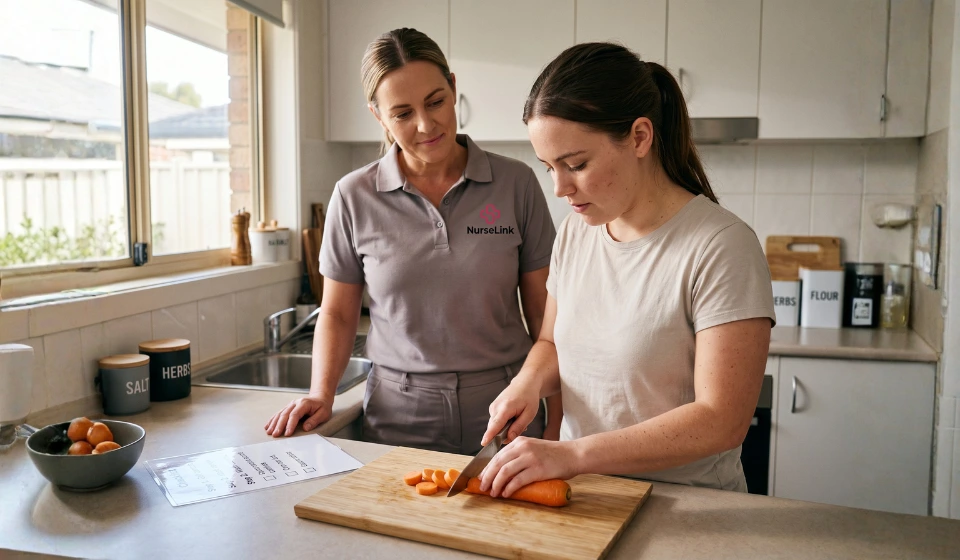
The early weeks of the engagement focused on rebuilding a modest, achievable daily structure, starting well below what the participant had once managed and deliberately avoiding the trap of setting expectations at her pre-episode baseline. The support worker helped her establish a simple morning routine, worked alongside her on manageable portions of household tasks rather than taking them over entirely, and helped her practise, gradually, some of the small daily activities, a short walk, a trip to the local shops, that had become disproportionately difficult during the worst of the episode.
Crucially, the support worker resisted the urge to move quickly even when the participant occasionally pushed herself to do so. On several occasions in the early months, the participant suggested taking on more than the plan called for, and the support worker, gently but consistently, encouraged her to hold the pace that had been agreed rather than accelerate it, understanding that a setback caused by overreach could undo more progress than a slower, steadier approach would ever cost.
Reconnecting With Her Children On Her Own Terms
A significant part of the engagement’s later stages focused on helping the participant rebuild her involvement in her children’s daily lives in small, manageable increments rather than attempting to resume her previous level of involvement all at once. The support worker helped her plan and prepare for a single, achievable point of reconnection each week, being present for one part of her daughter’s after school routine, preparing one family dinner with support, attending one part of her son’s school activities, rather than expecting herself to resume the full previous scope of her role immediately.
This incremental approach paid off in a way that mattered enormously to the family. Her daughter, who had noticed her mother’s withdrawal keenly despite being only eleven, began, over a period of a couple of months, visibly relaxing around her mother again as small, reliable pieces of their previous routine returned. Her son, whose own withdrawal had worried both parents considerably, responded more slowly, but began, by the later stage of the engagement, initiating brief conversations with his mother again in a way he had stopped doing during the worst of the episode.
Rebuilding Social Connection Beyond The Family
In parallel, the support worker helped the participant take small, carefully paced steps back toward the social connections that had fallen away. This began with simply accompanying her to the school gate at pickup time, a setting that had become a significant source of anxiety, standing beside her for the first several occasions before gradually stepping back as her confidence grew. It progressed, over subsequent months, to supporting a first, brief reconnection with the friend she had once seen weekly, a coffee arranged and attended together initially, then attended alone once she felt ready.
The support worker was careful throughout not to frame these steps as tests to be passed or milestones to be hit on a schedule, but as opportunities the participant could take up when she judged herself ready, with the support worker’s presence available as a form of scaffolding to be used for as long as it was needed and withdrawn only when the participant herself indicated she no longer needed it.
Working Alongside The Household, Not Around It
Throughout the engagement, the support worker maintained light but consistent communication with the participant’s husband, not to report on his wife in a way that would have undermined her sense of autonomy and privacy, but to ensure the whole family understood, in general terms, the pace and shape of the recovery being supported, so that expectations at home remained aligned with what was realistic and healthy. This coordination, kept deliberately light-touch, helped prevent the well-intentioned but potentially unhelpful pressure that can sometimes build in a family eager for a loved one’s full recovery.
Outcomes & Impact
A Sustainable Daily Structure, Rebuilt From The Ground Up
Over the course of the engagement, the participant moved from a period of significant functional decline to a modest, genuinely sustainable daily routine that she was managing largely independently by the later stage of the support period. Her psychiatrist, reviewing her progress at a scheduled appointment, noted that the pace and structure of her psychosocial support appeared to be complementing her clinical treatment well, with her overall trajectory continuing steadily in the right direction.
A Mother Reconnected With Her Children
The incremental reconnection with her children’s daily lives represented, by both parents’ account, one of the most significant outcomes of the entire engagement. She was, by the later stage of the support period, present for a meaningful portion of her children’s after school routines, cooking regularly again with some ongoing support, and had noticed, with visible relief, her daughter’s easy affection returning and her son beginning to talk to her again in the unguarded way he once had.
A Marriage Under Less Strain
Her husband, who had been managing a significant burden largely alone in the months before the engagement began, reported at a family review call that the shared load had eased considerably, both practically, as she resumed more of the household’s daily management, and emotionally, as he watched her regain pieces of herself he had feared, during the hardest months, might not fully return. He described the shift as allowing him, for the first time in a long while, to simply be her husband again rather than the household’s sole functioning adult.
The Beginnings Of A Social Life Beyond The Family
By the end of the documented engagement period, she had re-established regular, independent contact with her closest friend and had begun, cautiously, engaging again with the small community of other parents at her children’s school, attending a school event independently for the first time in over a year. Neither of these represented a full return to her previous social life, and neither was expected to. They represented genuine, self-directed steps that she had taken because she was ready to, at a pace that had been protected and respected throughout the engagement.
A Reflection From The Participant
Near the later stage of the engagement, she shared the following with the NurseLink Healthcare care coordinator:
“For a long time I felt like I had disappeared from my own family’s life. My husband was managing everything. My kids were eating dinners I had not cooked and going to school things I was not at. What my support worker gave me was not a push back to who I used to be. It was permission to come back slowly, one dinner, one school pickup, one coffee with a friend at a time, without anyone rushing me or measuring me against the person I was before. My daughter hugs me the way she used to again. My son talks to me again. I made dinner for my whole family last night, properly, the way I used to, and I sat at my own kitchen table afterwards and felt, for the first time in a very long time, like myself.”
Key Takeaways From This Case Study
Recovery support for a parent must account for the whole family system, not just the individual. A participant’s psychosocial recovery is deeply connected to how her family experiences and responds to that recovery, and support that considers the family’s needs and reactions, without compromising the participant’s own pace and autonomy, produces stronger and more sustainable outcomes.
Setting the baseline below the pre-episode standard prevents damaging setbacks. Recovery plans that aim for a modest, genuinely achievable daily structure, rather than a rapid return to previous capacity, protect against the kind of overreach and subsequent setback that can significantly delay genuine progress.
Incremental, self-paced reconnection succeeds where pressure fails. Both the participant’s reconnection with her children and her return to social contact worked because each step was taken on her own initiative and timeline, with support available but never imposed.
A parent’s guilt about the impact of her illness on her family needs to be addressed directly. This participant’s recovery was shaped significantly by support that acknowledged her guilt honestly and reframed her recovery as something the whole family welcomed at whatever pace it required, rather than something being measured against an unspoken deadline.
Light-touch coordination with the wider family protects the pace of recovery. Keeping other family members appropriately informed, without compromising the participant’s privacy or autonomy, helps prevent well-meaning pressure from undermining a carefully paced recovery plan.
Conclusion
A major depressive and anxiety episode can dismantle, quietly and comprehensively, the daily structure a family has depended on for years, and rebuilding it requires patience, genuine pacing and support that understands recovery as something to be protected rather than rushed. For the mother at the centre of this case study, NurseLink Healthcare provided psychosocial support that respected exactly that, helping her rebuild her daily life, her connection with her children and her place in her own household, one carefully chosen step at a time.
She is back at her kitchen table, cooking for her family most nights. Her daughter hugs her the way she used to. Her son is talking to her again. And she is, slowly and on her own terms, becoming fully herself once more.
If you or someone in your family is navigating recovery from a significant psychosocial episode, we encourage you to reach out to the NurseLink Healthcare team. We understand that coming back to yourself, and to your family, cannot be rushed, and we are here to support that process for exactly as long as it takes.
Latest Post
When Parents Learned to Trust NDIS Support
The Life He Thought The Accident Had Collapsed
Someone Finally Holding The Whole Picture
A Home That Was Finally His Own
Learning To Do It Herself, With Someone Beside Her
What Was Still Possible
Finding Her Way Back To Her Own Kitchen Table
From Aged Care To Her Own Front Door
She Was Ready. We Helped Her Get There.

Room To Breathe

The Man He Was Getting Back To
They Did Not Give Up On Him
Returning To Community Life
Rebuilding Independence After A Diabetes-Related Amputation
Cooking By Heart
The World Beyond The Front Door
Finding Home Again After A Stroke
Relearning Independence After A Life-Changing Accident
Beyond The Diagnosis
Two Years In Care. One Giant Step Toward Home.
When Transport Barriers Disrupted NDIS Care

Supported Independent Living Success
A Journey Towards Independence With NDIS Support

Daniel’s Journey