The Dinner Table Where One Person Couldn’t Follow The Conversation
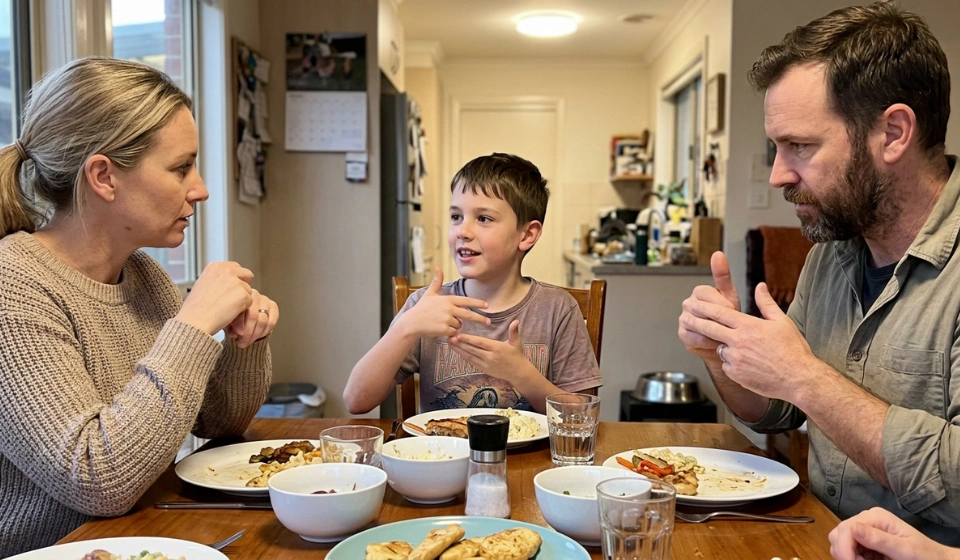
How NurseLink's NDIS Support Helped A Footscray Family Learn To Talk To Their Deaf Son
A Case Study In Sensory Disability Support That Treated Communication As A Family Skill, Not Just A Participant Goal
Introduction
When a child is born deaf into a hearing family, the early years tend to be dominated by the practical: audiology appointments, assessments, equipment, early intervention and decisions about communication approaches that no parent expects to have to make. Families often manage this period with remarkable energy and commitment. What is far less visible, and far less often funded or discussed, is what happens later, when the child is older, the appointments have thinned out, and the family realises that despite everything they have done, one person at the dinner table is still quietly missing most of the conversation.
For a deaf child in a hearing household, exclusion rarely looks like exclusion. It looks like a child who nods along, smiles when others laugh, and learns to read the room well enough to avoid being caught out. It looks like jokes that get explained later, if they get explained at all. It looks like a family that loves each other deeply and communicates, on a daily basis, in ways that only partly include one of its members. Over years, the gap becomes a part of ordinary family life, unspoken precisely because nobody intends it.
Good NDIS support for a child with a sensory disability recognises that the participant’s goals cannot be achieved in isolation from the people around him. If the family cannot communicate with him fluently, no amount of individual support will fully close the gap. This case study documents how NurseLink Healthcare supported a family in Melbourne’s inner west, hearing parents and siblings of an eleven-year-old Deaf boy, to build the shared communication that had been missing from their home, and how treating the whole family as the client changed the way every member of it experienced everyday life together.
To protect the privacy of the participant and his family, all names and identifying details have been kept confidential throughout this case study.
The Client & Her Situation
The family lives in Footscray and consists of two hearing parents, an older sister aged fourteen and a younger brother aged eight, alongside the participant, an eleven-year-old boy who is profoundly deaf. His parents had followed professional advice throughout his early childhood, pursuing hearing technology and speech therapy, and had also begun learning Auslan, Australia’s sign language, when he was around five. But Auslan is a full language, and learning it as an adult alongside work, a household and two other children is slow. Six years on, his parents could manage everyday basics, greetings, simple requests, short exchanges, but not the kind of fluent, flowing conversation that makes up most family life.
His siblings, who had learned some signs from him directly, communicated in a bright but limited way. His older sister, in particular, had developed a habit of translating for him at family gatherings, sitting beside him and signing summaries of the conversation a few moments after it happened. She had done this faithfully for years, and the family had come to rely on it without really thinking about what it asked of her, or what it meant that her brother’s access to his own family’s conversation depended on a fourteen-year-old.
The participant himself was bright, funny and well-liked at school, where he had an Auslan-fluent aide. At home, his support coordinator observed, he was noticeably quieter. During the first planning conversation, he was asked, through an interpreter, what he would change about his life if he could change one thing. He thought for a while and then signed that he wished dinner was not so boring. His mother, watching the interpreter, realised with a jolt that what he meant was not the food.
Understanding What The Family Actually Needed
The initial NDIS planning conversations identified goals around communication, social participation and independence, but the NurseLink Healthcare coordinator who joined the family early in their plan year recognised that the goals as written risked missing the point. They focused on the participant, his communication skills, his social connections, his confidence. But the real constraint was not his capability. It was the family’s shared fluency, and the fact that nobody, including the family themselves, had ever framed that as the thing to be worked on.
The family needed, first, a support person fluent in Auslan, ideally from the Deaf community, who could work alongside the boy outside school hours, giving him a fluent communication partner and, equally importantly, a model of what confident Deaf adulthood could look like. Many hearing families raising deaf children have never had meaningful contact with Deaf adults, and the participant had met very few.
They also needed practical, structured support for the family’s own Auslan development, not as an afterthought to the participant’s goals but as a central element of them. His parents wanted to talk to their son properly and had no idea how to get from where they were to where they wanted to be, given the demands of daily life.
His sister, the coordinator recognised, needed something quieter and just as important: relief from the unspoken role she had been carrying, and recognition that being a good sibling did not require her to act as her brother’s permanent interpreter.
The NurseLink Healthcare Solution
A Deaf Support Worker Chosen As A Communication Partner & A Role Model
NurseLink Healthcare identified a support worker who was herself Deaf, a native Auslan user with experience supporting children and young people and strong connections within Melbourne’s Deaf community. Her role was framed from the outset not as a translation service but as genuine, fluent companionship for the participant, with the added value of showing him that a Deaf adult could be funny, capable and entirely at home in the world.
After-School Support Built Around Real Interests
Support sessions were structured around the participant’s own interests, in his case, drawing, football and an enthusiasm for stop-motion animation, rather than formal skills practice. For the first time, he had regular hours each week in which every conversation was fully accessible and in which nothing needed to be simplified, repeated or explained afterwards.
Family Auslan Learning Built Into The Plan
Working with the family and their support coordinator, NurseLink Healthcare built structured family Auslan learning into the plan, including regular sessions in which the support worker and, where appropriate, an Auslan tutor worked with his parents and siblings together at home. The emphasis was on the language of ordinary family life, mealtimes, jokes, arguments and plans, rather than on vocabulary lists, so that learning was directly connected to the conversations the family actually wanted to have.
A Dinner Table Practice That Changed The Evening
One of the simplest and most effective changes came from a suggestion that the family hold one dinner a week in Auslan only. The first few were awkward, slow and full of laughter at errors, but the participant, for the first time, was the most fluent person at the table, and the family experienced, in a small and sometimes humbling way, what it was like to follow a conversation at someone else’s pace.
Quietly Removing The Interpreter Role From His Sister
The coordinator spoke gently with the participant’s parents about the load his older sister had been carrying, and the family agreed that she would be relieved of the translating role at gatherings. The support worker and the parents’ growing skills gradually took over, and his sister reported feeling, with some surprise, that she could finally just be a sister.
Connecting The Family To The Deaf Community
Through the support worker, the family was introduced to Deaf community events, including a Deaf sports club for children and a regular social gathering for Deaf families. For the participant, this meant meeting peers who shared his language and experience. For his parents, it meant meeting hearing parents of Deaf children further along the same path, and seeing what was possible.
Outcomes & Impact
The Participant Became Part Of Family Conversation, Not Just The Family
Within several months, his parents noticed that he was contributing to conversations at home in a way he had not before, offering opinions, telling stories and, at one memorable dinner, winning an argument with his father. His mother described the shift as watching a quiet child become a talkative one.
His Parents' Auslan Developed Meaningfully
Their signing grew steadily more fluent through consistent practice and a supportive learning environment, and by the end of the plan year they could hold simple but real conversations with their son without relying on an interpreter or on his sister.
His Confidence Grew Across Settings
His school aide reported that he appeared more confident in class, more willing to contribute and less inclined to withdraw in social situations, a change the coordinator and family attributed to the cumulative effect of feeling fully included at home and connected to a Deaf peer group outside it.
His Sister Was Freed From An Unspoken Burden
His older sister, who had translated for her brother for years, told the coordinator that she had not realised how heavy the role had felt until she was allowed to put it down. Her relationship with her brother, she said, had become more equal and more fun.
The Family Gained A Shared Identity
Perhaps the most significant change was less measurable. The family began to describe themselves, with some pride, as an Auslan-using household rather than a hearing family with a deaf child, a shift in identity that changed how they spoke about their own situation and how they imagined their son’s future.
A Reflection From The Participant's Mother
Several months into the arrangement, the participant’s mother shared the following with the NurseLink Healthcare coordinator:
She said that for years she had believed she was doing everything right, because she had followed every piece of advice, attended every appointment and learned what she could of Auslan, and that it had never occurred to her that her son could be sitting at their own table feeling left out. What changed things for her was a support worker who communicated with her son in a way she had never seen, easily and fully, and who, without ever making the family feel judged, showed them what a different kind of conversation looked like. She said the first Auslan-only dinner made her cry, partly from frustration at her own clumsiness and partly from seeing her son light up because everyone was finally speaking to him in his language. She added that she wished someone had told the family years earlier that the goal was never just to help her son communicate with the hearing world, but to make sure the people who loved him most were fluent in his.
Key Takeaways From This Case Study
For a deaf child in a hearing family, exclusion at home is often invisible because no one intends it. Children adapt by nodding along and reading the room, and families can go years without realising how much of everyday conversation is passing them by.
Family communication is a participant outcome, not a separate project. Treating the family’s shared language skills as central to the plan, rather than as a bonus, addressed the real constraint on the participant’s inclusion.
Deaf role models change what a child believes is possible. Regular time with a fluent, confident Deaf adult gave the participant something no hearing professional could, and gave his parents a clearer picture of his future.
Siblings often carry unspoken roles that deserve attention. Relieving his older sister of the interpreter role improved her wellbeing and her relationship with her brother.
Small, regular practices change family life more than occasional intensive effort. A weekly Auslan-only dinner did more for shared fluency and family connection than any amount of well-meant intention.
Conclusion
A family that had done almost everything right, and still had a quiet gap at the heart of its daily life, found through thoughtful NDIS support that the gap could be closed by changing how the whole household communicated, not just by supporting one member of it. For the family at the centre of this case study, NurseLink Healthcare provided not only an Auslan-fluent support worker and structured learning, but a way of seeing communication as something a family builds together.
The boy who once found dinner boring now argues with his father at the table. His sister gets to be a sister. And a Footscray household has become a place where everyone, finally, is part of the conversation.
If your family is supporting a child with a sensory disability, we encourage you to reach out to the NurseLink Healthcare team. We support the whole family, because inclusion starts at home.
Latest Post
When Parents Learned to Trust NDIS Support
The Life He Thought The Accident Had Collapsed
Someone Finally Holding The Whole Picture
A Home That Was Finally His Own
Learning To Do It Herself, With Someone Beside Her
What Was Still Possible
Finding Her Way Back To Her Own Kitchen Table
From Aged Care To Her Own Front Door
She Was Ready. We Helped Her Get There.
Room To Breathe
The Man He Was Getting Back To
They Did Not Give Up On Him
Returning To Community Life
Rebuilding Independence After A Diabetes-Related Amputation
Cooking By Heart
The World Beyond The Front Door
Finding Home Again After A Stroke
Relearning Independence After A Life-Changing Accident
Beyond The Diagnosis
Two Years In Care. One Giant Step Toward Home.
When Transport Barriers Disrupted NDIS Care
Supported Independent Living Success
A Journey Towards Independence With NDIS Support

Daniel’s Journey